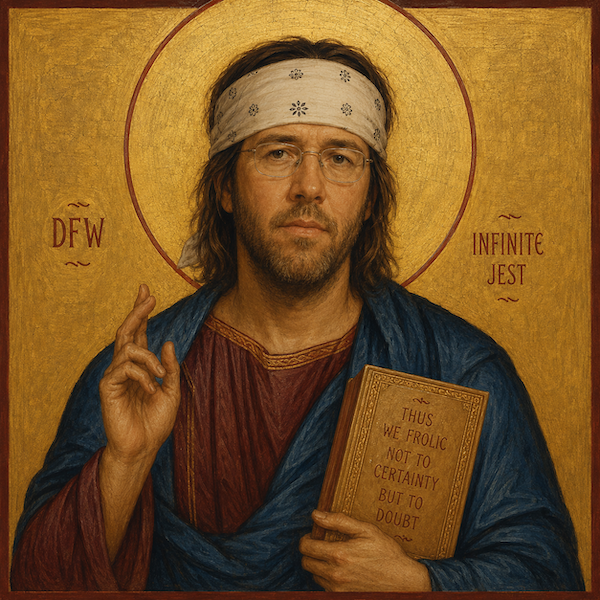
The Writer Who Brought Me to My Knees, or the Gospel According to a Heathen
Table of Contents
- 1. The Writer Who Brought Me to My Knees, or the Gospel According to a Heathen
- 1.1. The Path of a Normie
- 1.2. The Central Theme
- 1.3. Black Hole of Pain
- 1.4. Meanings Make Recovery Possible
- 1.5. Why You Should Read "Infinite Jest"
- 1.6. Lethal Drugs in "Infinite Jest" and Real Life
- 1.7. Killer Movies Are Worse in Real Life Than in "Infinite Jest"
- 1.8. Why You Should Read "Infinite Jest"
- 1.9. The Solution
- 1.10. Minimal Viable Religion
- 1.10.1. Requirement Nr. 1: Compliance With Laws of Nature, Including Logic
- 1.10.2. Requirement Nr. 2: No Hostility in Dogmas and Behavior
- 1.10.3. Requirement Nr. 3: Help the Individual Avoid Repeating the Same Mistakes
- 1.10.4. Requirement Nr. 4: A Religion Must Hint at a Mission Big Enough to Motivate
- 1.10.5. Requirement Nr. 5: Rational Immortality
- 1.11. How to implement the Minimal Viable Religion
- 1.12. Requirement Nr. 1: Compliance With Laws of Nature, Including Logic
- 1.13. Requirement Nr. 2: No hostility in dogmas and behavior
- 1.14. Requirement Nr. 3: Help the Individual Avoid Repeating the Same Mistakes
- 1.15. Requirement Nr. 4: A Religion Must Hint at a Mission Big Enough to Motivate
- 1.16. Requirement Nr. 5: Rational Immortality
- 1.17. Part of the Solution
1. The Writer Who Brought Me to My Knees, or the Gospel According to a Heathen
Hi, there!
Some time in 2025 I decided I want to read something by David Foster Wallace. I don't remember why I got that craving. But I went to Amazon and bought "Infinite Jest." This decision spawned a series of surprising consequences.
The first surprise was the language. "Infinite Jest" is a "best of" undocumented features of the English language. It left me with the feeling that if DFW can bend the grammar and invent new words, why can't I? The language isn't set in stone, and writers are supposed to modify it and keep it alive.
The second surprise was the length of the book. On Amazon, you only see the cover, and I didn't look at the page count. In retrospect, I feel DFW wanted the reader to receive and understand a very important message. The length of the novel may be the literary equivalent of grabbing someone by their shirt, telling them the message in their face, and holding them so they can't run away from the unpleasant truth.
I spent months reading this novel. It took me on a journey which ended up with me praying on my knees multiple times a day. People often say that the US doesn't have a spiritual tradition (or that the US is less spiritual than other countries). I think they are wrong and books like "Infinite Jest" may lead more people to the right spirituality than sermons of mainstream Christians.
If you want to find out how "Infinite Jest" does it, read on.
1.1. The Path of a Normie
There are multiple plotlines in the novel. One of them is about a well-to-do community of tennis players. The other one plays among Alcoholics Anonymous and Narcotics Anonymous (NA).
At first glance, they share little except location (the NA building is located close to the tennis academy).
If you look at most characters in the novel, they seem to go through a path which looks as follows:
- Live like a normie.
- Hit rock bottom.
- Recover.
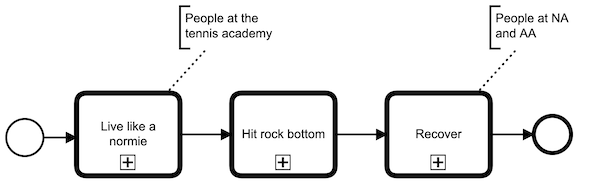
Living a normal life is making a person addicted. This includes the upper middle-class people at the tennis academy. Virtually everyone either takes drugs or engages in other questionable behavior (like affairs with pupils).
A normie gets more and more addicted until he or she hits rock bottom. Then, they get to AA or NA and begin to recover.
The difference between the upper-middle-class people at the tennis academy and the AA/NA people is that the latter are further down the path.
1.2. The Central Theme
In December 2025, I received news that the budget for the team I was working in was cut and I would be transferred to another one. I got nervous because the job market wasn't as it used to be (there was only one inbound interview invitation, and it came from the Russian branch of Virtucon). I had enough gold to survive for six months without working, but when I read about the everyday life of homeless addicts, it felt very relatable. Much more relatable than it should have been, given that I never took drugs and the last time I drank alcohol was back in fall 2024.
After a while, I realized it wasn't homelessness that connected me and the characters of "Infinite Jest." It was an addiction.
1.3. Black Hole of Pain
There is a stratum of people who can't live without having a purpose or seeing a meaning in their lives. They are addicted to meaning.
If they can't find or create viable meanings, they begin to self-destruct.
This is not irrational. The lack of meaning feels like a black hole of pain.
One morning in 2023, I woke up in my little apartment and had this unusual feeling of being completely alone in the universe. It was the same apartment as before: the same walls, ceiling and window. But on this morning I felt so utterly lonely that I would have done anything to make this feeling stop.
This was a special flavor of loneliness. I spend most of my time alone, and it's never been a problem.
What I felt that morning was concentrated loneliness, as if someone had given me amphetamines and by doing so made me more aware of the pain.
This feeling went away after probably a few minutes. But I will never forget it, and it is probably one of the closest approximations of hell I ever experienced.
If that hadn't gone away, I might have done something destructive. Maybe it's feelings like these that turn people into addicts.
1.4. Meanings Make Recovery Possible
If someone gets addicted (or self-harms) it could mean their failure to come up with meanings (purposes) that make them function.
When addicts do the AA/NA programs, they not only deal with biological issues. They also create their personal meanings in their souls which–if successful–will allow them to exist in the face of black holes of pain like the one I had in 2023.
1.5. Why You Should Read "Infinite Jest"
You may claim that you aren't an addict and therefore reading "Infinite Jest" is useless for you.
Before reading "Infinite Jest," I also believed I'm not an addict. I rarely drink alcohol; I never took drugs, and I never smoked.
Several months into reading "Infinite Jest" and feeling compassion for one of the recovering addicts from the book, I realized that it's not only cigarettes, alcohol, and illegal drugs you can become addicted to.
1.6. Lethal Drugs in "Infinite Jest" and Real Life
In "Infinite Jest," there is a movie that someone brought into circulation. Everybody who watches the movie can't stop watching it. The only thing they want to do is watch this movie over and over again.
Question: Do we have something similar in real life in 2026?
Another question: The device you are reading this text on right now, can you watch YouTube on it? Or TikTok, or Instagram?
Do you regularly consume content on platforms like these?
Do you sometimes watch YouTube even though you know that a particular person is wrong and you get angry, but still watch it?
(Which is like a smoker who knows smoking is bad for him or her, but who does it nonetheless.)
If so, you may carry the equivalent of the killer movie in your pocket.
But it's actually worse in real life than in "Infinite Jest."
1.7. Killer Movies Are Worse in Real Life Than in "Infinite Jest"
In the novel, the killer movie is made by a director and a small team. In our reality, internet addiction is a billion-dollar industry. The best brains in the world are constantly thinking about how to make you consume more content.
In the novel, the law enforcement has a chance of taking the killer movie out of circulation.
In our reality, it's impossible for a variety of reasons. The killer video from "Infinite Jest" takes you out of commission quickly. The countless cat videos on YouTube kill you by a thousand cats, and there is no way anyone will censor a cat video.
1.8. Why You Should Read "Infinite Jest"
We are all addicts now, but many of us don't realize it.
If you read "Infinite Jest," you may realize that you are an addict on a visceral level. Like I did when I empathized with a homeless drug addict and felt like DFW was telling the story of my life (even though the closest I got to homelessness was when I was bumming around in Moscow's hostels, but that's a topic for another post).
Feelings like these may scare the shit out of you. This is good because then you may do something about your addiction.
For example, I took one afternoon to remove all my YouTube subscriptions. There were several thousand of them. Then I disabled saving history so YouTube can't recommend me new drugs videos I may want to watch based on my specific addiction viewing history.
Regard "Infinite Jest" not as entertainment, but as an investment in preemptively improving your mental health.
1.9. The Solution
Reducing YouTube consumption isn't the whole solution. Addicts crave meaning, remember?
YouTube and similar platforms provide mass-produced substitutes for those meanings. YouTube is to a true system of meanings what an inflatable sex doll is to a loving, sane, and healthy trad wife.
There must be a mechanism that helps a person assemble and operate such a system of meanings tailored to the particular person.
One could say that religion is supposed to be that mechanism. Theoretically, this is true.
In practice, not so much.
Every addict, chemical or digital, is a failure of religion to support the individual in building their own system of meanings. The more addicts there are in a country, the worse the dominant religions function.
If we want to fight addiction, collectively and individually, we need to create a new religion.
1.10. Minimal Viable Religion
Let's sketch out a few requirements that a religion must satisfy in order to be an effective and efficient addiction blocker.
1.10.1. Requirement Nr. 1: Compliance With Laws of Nature, Including Logic
The target audience of a minimum viable religion are sense-addicted people. Many such people, especially those who have either experienced serious addiction or got close to it, are allergic to lies.
Therefore, the main precepts of a minimal viable religion must comply with the laws of nature and logic.
An addict, especially a recovering one, has a BS detector in their brain. They know that the wrong kinds of beliefs can kill them, so they filter out incoming information for signs of lies or unproven claims.
Here are a few examples of claims which are unlikely to pass the BS filter of a recovering addict:
- Macroevolution and social Darwinist theories derived from it. Nobody has managed to replicate macroevolution in a lab or provide hard proof for it. Therefore, it's just a theory you can choose to believe or not to believe.
- Freudian ideas that all people are motivated only by desires for sex, money, power, etc. It's enough to find one person who does something without being rewarded by sex, money, or power to disprove the idea.
- Western societies value human life more than non-Western ones. The fact that Western societies have been trying to destroy Russian society since at least 1941 is only one example that disproves this idea.
1.10.2. Requirement Nr. 2: No Hostility in Dogmas and Behavior
There are certain things that you aren't supposed to do to people you consider friendly or neutral. You only hit, defraud, or lie to an enemy.
No religion can be true if the first encounter with it starts with something hostile, such as manipulation or outright rude behavior.
Here are a few counter-examples:
- Claims that members of a particular ethnicity have to be members of a particular church. It's an attempt to dominate you disguised as spirituality.
- Official Christians behaving worse (less Christian) than average humans in that region.
- When someone wants you to claim that you believe in impossible things, it's not spirituality; it's brainwashing.
1.10.3. Requirement Nr. 3: Help the Individual Avoid Repeating the Same Mistakes
There are certain mistakes that societies tend to repeat. A minimal viable religion must help the individual and society avoid repeating these old mistakes.
If you look at many Eurasian societies over the last 200 years, you may notice that intellectuals there believe
- these societies are hopelessly retarded and
- therefore need to be absorbed by the allegedly more advanced West.
The facts don't support this view. Most of these societies achieved peak prosperity when they tried to walk their own, non-Western way (USSR). Yet, despite abysmal results, these societies prefer to fight each other (e.g. in Ukraine) instead of together fighting the common enemy (the collective West).
Other societies may have other mistakes they love repeating.
For example: For a long time, people in several very different countries (incl. but not limited to Austria, Germany, Russia, Ukraine, Britain) were supposed to take care of themselves, do their little business or build their little career, and not to think too much. You were supposed to leave politics to those who understand it and don't be particularly principled.
Then, suddenly, some of those people found themselves
- locked up in their homes without due process for months,
- being treated as subhumans by many of their service providers,
- in bomb shelters, or
- trying to defend themselves from folks who want to behead them and from the police who want to arrest them for talking about that.
The recurring mistake all those people made was to think you can prosper without fighting against the elites.
A minimal viable religion must help the individual avoid such common mistakes. This can happen through the accumulation of knowledge over multiple generations. Part of religious practice must be passing knowledge on to your kids and/or other people you care about.
(Since the children are usually different from the parents, requirements nr. 1 and 2 make passing on such knowledge possible.)
1.10.4. Requirement Nr. 4: A Religion Must Hint at a Mission Big Enough to Motivate
Sometimes addicts love other people more than they love themselves. This can be harnessed to help the addict stay clean.
A minimal viable religion must hint at ways how the individual can do something extremely valuable for many other people.
An obvious example is storytelling. I do my best to stay clean so that I can write more, so that I may write something that helps other people survive and prosper.
There are other ways to care for others, which I will explain below.
1.10.5. Requirement Nr. 5: Rational Immortality
When I had my black hole moment in 2023, a big part of what made it painful was the feeling that I might die completely and nothing will be left of me after death.
We can face death in better ways if we find a way to survive it, at least symbolically.
A minimal viable religion must provide ways for an individual to have a feeling of immortality without violating laws of nature and logic (requirement nr. 1).
1.11. How to implement the Minimal Viable Religion
Now that we have the requirements for a minimal viable religion, how can we build it?
If you are a recovering addict like myself, you need to build it relatively fast.
(Before another black hole event strikes…)
I assume that no religion has been created out of thin air. Christianity was based on Judaism. Judaism was based on Canaanite, Mesopotamian, and ancient Egyptian religions.
For a person living in a society which claims to be Christian, it makes sense to breathe new life into Christianity by making it compliant with the requirements of a Minimal Viable Religion.
1.12. Requirement Nr. 1: Compliance With Laws of Nature, Including Logic
Christianity becomes much more appealing if we remove the illogical parts from it. I claim that interpretations of the New Testament accepted by most mainstream branches of Christianity cannot be true.
Before I explain why, let's document some assumptions.
- Assumption nr. 1: Human nature has changed little during the last 2000 years.
- Assumption nr. 2: A person who resembles Jesus did live somewhere in Eurasia and attracted a following.
- Assumption nr. 3: The person from assumption nr. 2 was murdered.
If assumption nr. 1 was false, the teaching from 2000 years ago would be irrelevant today.
I won't go into details regarding assumptions 2 and 3 because I think they can be defended even by a materialistic scientist who doesn't believe in Jesus.
Most churches focus on Jesus rising from the dead after he was killed. They don't explain the reasons why he was killed.
1.12.1. Kingdom of God in mainstream Christianity
Let's look at the official line. Jesus teaches about kindness, compassion, loving thy neighbor, and heals people. He encourages people to build a "Kingdom of God" either in their souls or in the afterlife. Then, the Roman elites decided to kill him.
From assumption 1 follows that in order for the Romans to want to kill Jesus, they must have had a rational motive to do so.
How does being kind to others and thinking about the afterlife endanger the Roman elites?
1.12.2. Kingdom of God without BS
There is an alternative way to interpret the New Testament.
Jesus lived in a country occupied by a foreign power. It's the mismanagement by the Israeli elites that led to this situation.
Those elites, represented by the Sanhedrin, seem to like this occupation arrangement because they don't oppose it.
We can assume that Jesus was a highly talented human and as such he could predict where ancient Israel would end up if the elites continued his policy. The destination would be fiery Gehenna, a place so tormented by incessant wars that its fires were believed to never die.
A "Kingdom of God", then, is a form of societal organization which acts in the long-term interests of ancient Israelites than that dominated by the Sanhedrin.
To build the Kingdom of God means to replace the current form of government with a better one. To do this requires the aggregation of the efforts of many people. Jesus' followers probably were such people.
If we accept such a hypothesis,
- the actions of the Romans become logical,
- the willingness of Christian martyrs to die for their beliefs becomes logical, and
- the teaching becomes relevant in 2026.
1.12.3. Jesus' political agenda makes conflict with the Romans logical
Jesus wanted Israeli society to be more effective and efficient in pursuing its own (Israeli) long-term interests, not those of
- foreign occupiers and
- local elites who were in cahoots with them.
The existing arrangement satisfied both the occupiers and the local elites. It may have been codified in law.
According to assumption 1, how often was one social order replaced with another peacefully?
This means that Jesus and his followers wanted to replace the social order in the most frequently used way – through violence.
In the modern US, such actions may fall under seditious conspiracy (18 U.S.C. § 2384) and rebellion or insurrection (18 U.S.C. § 2383). The punishment is up to 20 years' imprisonment.
In ancient Israel, the punishment for such "crimes" may have been harsher, and this is why Jesus was executed.
1.12.4. Jesus' Political Agenda Makes Martyrdom Reasonable
There are many stories about early Christian saints who preferred to die under torture than denounce Jesus' teaching.
If Jesus taught that the ancient Israelites had to fight the elites to make them act in the long-term interests of the Israeli population, then Jesus' teaching was about ensuring the survival of the Israeli nation in the long run.
Jesus' followers may have seen themselves as a kind of people who managed to do something for the future of their society. Whether 2000 years ago or now, such people are extremely rare.
Imagine one such saint being given the choice to renounce Jesus' teaching or die. If he chooses to die, it may inspire other people to follow Jesus' teaching, i.e. to do something for the survival of their society. If such a saint can focus on the long-term outcome instead of his immediate pain, he may rationally choose to die for the cause as a way to attract new followers and thus increase the likelihood of his or her society surviving.
It is possible that the early Christian saints followed the logic of Soviet heroes in WWII. Back then, the collective West under German leadership invaded Russia and tried to exterminate the local population. In the early phases (1941) the Germans were winning decisively. People like
were captured by the Germans and chose to die under torture rather than cooperate with them.
Whoever learned about their martyrdom would inevitably ask themselves: They refused to help the Germans even at the cost of their lives and dignity. Could it be that they did this so that someone, e.g. me, would get another chance at defeating the Germans?
The Darlings sing
Never give them control!
They've got their money but we′ve got our soul!
That soul is the part of the psyche which makes a person buy the lottery ticket of long-term survival of others with their own painful death… and by doing so convincing others that their cause (survival of the society) is worth living and dying for.
1.12.5. Jesus' Political Agenda Makes His Teaching Relevant in 2026
A no-BS reading of the New Testament shows a world where
- your country is occupied by a foreign power,
- your elites cooperating with the aggressor, and
- life is getting worse and worse for the average person.
Sounds familiar, doesn't it?
Oligarchs like Elon Musk and most of the political establishment (influenced by AIPAC) would be the American analogs of the Sanhedrin. Most other countries are also controlled from outside.
1.13. Requirement Nr. 2: No hostility in dogmas and behavior
1.13.1. The Nicene Creed
The overwhelming majority of branches of Christianity follow the Nicene Creed, which mandates that you believe that
- Jesus was a god (not a human like you and me),
- Jesus was born to a virgin,
- Jesus rose from the dead, and
- ascended into heaven.
Statements 2 and 3 are impossible according to the laws of nature as we know them; statement 4 is unprovable (unfalsifiable).
If you want to join a Christian church, you need to force yourself to believe in things that are wrong or unprovable.
Question: Would you force a loved one to believe (or pretend to believe) in obviously false statements?
Probably not, because saying things you don't believe is a manipulation technique which usually aims at making the target voluntarily give up their thinking freedom.
Imagine a normal person is presented with an unrealistic claim, such as virgin birth. Without extraordinary evidence, they will reject the claim as false. They know the laws of nature and the laws of logic. They may be willing to revise the understanding of them, but only after sufficient proof.
In other words: A normal, healthy person decides himself (herself) what's true and what's not.
If you manage to break a person's spirit, they may accept other people's ideas without scrutiny. Brainwashing like this may happen when prisoners of war are "reeducated" into the ideology of their captors.
Mainstream Christianity seems to employ brainwashing masquerading as the Nicene Creed to its own members.
Isn't breaking someone's spirit a hostile action, something you only do to your enemies?
Isn't indoctrinating children with obviously false beliefs equally unethical?
1.13.2. Where the Nicene Creed Needs to Go
I believe that the Nicene Creed was an attempt by the elites to destroy Christianity. Jesus' teachings were extremely dangerous to the elites.
They tried to kill the teaching by killing the leader, and it didn't work.
So they decided to corrupt the teaching. A talented human became "Son of God," and the focus went from fighting the elites in this life to bodily resurrection, virgin births, ascensions, and the building of the kingdom of God in the afterlife.
The Nicene Creed was the vehicle which moved Christianity from fighting foreign-controlled elites around 30 A.D. to praying for them in March 2025.

Figure 1: Faith Leaders Pray Over President Trump at the White House Source
1.13.3. The Cardinal Sin
Mainstream Christianity also wants you to believe that the human is inherently flawed and guilty of the cardinal sin (even as a newborn).
Imagine a recovering addict coming to Christianity. Such a person won't be very strong psychologically because they hit rock bottom recently. Do you think it's conducive to their recovery to tell them are inherently bad?
Of course not. It's much healthier to frame the cardinal sin as a type of mistake a person or society tends to repeat. This is much more helpful because you can avoid repeating a mistake (but you can't rid yourself of the cardinal sin).
1.14. Requirement Nr. 3: Help the Individual Avoid Repeating the Same Mistakes
Above I wrote we should pass on valuable knowledge from generation to generation. Book of Revelation 1:11 says
Write down what you see […]
Remember: John lives in a world where a foreign power occupies his ancient Israel and the oligarchy is fine with it. I don't know how it was in ancient Israel, but I know that in 2026, when a colonizer (e.g. the US, the UK, the EU) wants to keep control over the colony (e.g. Russia, Ukraine) they have to make sure that the education system indoctrinates the population the way the colonizers want.
This means: If you want your kids to grow up as functioning adults, you can't trust the education system and the media. You have to educate the children yourself and give the vital knowledge that the education system and the media won't.
Part of it is taking the knowledge you gained through your own experience, writing it down, and passing it on to the next generation.
1.15. Requirement Nr. 4: A Religion Must Hint at a Mission Big Enough to Motivate
If the Kingdom of God is a better way of societal organization than the current one, then a good Christian is someone who contributes to building such a society to the best of their abilities.
There are at least three roles a person can take in building such a society.
- Writer
- Entrepreneur
- Warrior
1.15.1. Writer
Before a new society can be built in practice, it must be built in people's minds. Before there were the Russian and Chinese revolutions, there was Marx's Das Kapital. Before smartphones and tablets became reality, they were introduced in the 1960s in Star Trek. Something which allows the population to exert influence on the elites regularly is an invention which can take many brains to develop.
It's the job of writers to invent such mechanisms and show them in fiction books.
1.15.2. Entrepreneur
Entrepreneurs are required to build companies which may result in a more people-oriented economy.
1.15.3. Warrior
In order for writers and entrepreneurs to survive and work, warriors must defend them from foreign occupiers and allied local oligarchs.
The latter won't give up their power without a fight. As much as I hate violence, building a Kingdom of God in real life is unlikely without someone fighting.
Let me give you a few examples of what building a Kingdom of God looks like today.
1.15.4. Example 1: Russian Revolution (1917–1922)
In 1917 the Socialists took power in Russia and built a society which, in many ways, was better for most inhabitants of Russia than Tsarism.
The revolution and the Civil War led to casualties in the millions, but you can make a case that it was a price worth paying for the prosperity of generations that followed them (esp. from 1945 through 1985).
1.15.5. Example 2: Donbas (2014)
In 2014, a highly destructive regime came into power in Ukraine as part of a coup.
In the Donetsk and Lugansk regions, enough people didn't want to live under such a regime and fought to secede from Ukraine (after eight years they became part of Russia in 2022).
Hadn't they fought for over eight years, they would now live like the rest of Ukraine does (with busification and a ban on speaking the language most Ukrainians speak in private, intimate conversations).
Compared to Ukraine in 2026, Russia of 2026 is a Kingdom of God (significantly freer than Ukraine, despite all the problems).
You could argue that by fighting for over eight years, the people in Donetsk and Lugansk bought themselves a much better life than they would have if they had stayed in Ukraine.
This example also shows how the famous quote by Seraphim of Sarov can work in practice.
Save yourself, and thousands around you will be saved.
Many defenders of Donbas were probably as opposed to violence as I am. They saved themselves, i.e. acquired a state of mind which allowed them to do what's right (fight against armed Nazis) despite their pacifism.
Their fighting saved millions of inhabitants of the Lugansk and Donetsk regions from war crimes committed by the illegal Kiev regime.
Note that those Donbas fighters are doubly heroic because they fought both against the Kiev regime and the Moscow officials who supported it (see 85 Days in Slavyansk for a history of the conflict).
1.15.6. Example 3: Iran (1951–ongoing)
Remember the story about ancient Israel being occupied by a foreign power, with the local elites being in cahoots with the occupiers?
Let's look at the history of Iran and see if there are parallels.
After WWII, Iran was under the strong influence of foreign powers, especially the UK and the US. Among other things, the Anglo-Persian Oil Company de facto belonged to the British government.
After over 30 years of struggle, the Iranian elites managed to install a regime more favorable to the long-term interests of the Iranian people. After 1954, the oil profits of the Anglo-Persian Oil Company stayed in Iran and have likely supported the many improvements that Iranian society experienced since the removal of the foreign-controlled Shah (life expectancy, infant mortality, literacy, university students).
We can say that the Iranian elites managed to implement Jesus' vision:
- They removed the foreign-controlled elites represented by the Shah (1951–1979).
- They've been improving their country from 1979 on.
- Their elites were honest enough to resist the attempts to buy them off (contrary to so-called Russian and so-called Ukrainian elites).
- As of 2026, they continue to successfully defend themselves from the West and its proxies (Israel and others).
This is the Christian mission well-executed over multiple generations.
1.15.7. Objection Nr. 1
You may say: "But Pravles, the Iranians are Muslims, that is, heathens from the Christian point of view?"
To this I, a proud heathen, say:
- Mark 11:17 (my emphasis): "My Temple will be called a house of prayer for the people of all nations."
- Luke 4:25–27: Here Jesus claims that the prophets Elijah and Elisha were sent to Gentiles (who are the equivalent of heathens for mainstream Christians).
- In Matthew 28:19 Jesus says (my emphasis) "Go, then, to all peoples everywhere and make them my disciples." People in foreign lands are likely to have different (other than Judaism) religions. Jesus says they can be as good Christians as those who converted from Judaism.
- Galatians 3:26–28 (my emphasis): "It is through faith that all of you are God's children […] So there is no difference between Jews and Gentiles, between slaves and free people, between men and women; you are all one in union with Christ Jesus."
- Romans 10:11–12: "The scripture says, 'Whoever believes in him will not be disappointed.' This includes everyone, because there is no difference between Jews and Gentiles."
1.15.8. Objection Nr. 2
I hear another objection: "You can 'prove' any piece of BS with a Bible quote."
True, but BS won't pass my requirement nr. 1. Unless you can prove to me that white Christians are better in some way (e.g. have a larger brain) than non-white and/or non-Christians, I don't see a reason why we can't learn from the Iranians how to take back our country.
1.15.9. What Does All of That Have to Do With Me?
Those examples show it is possible to implement the true Christian mission in our time. Every society is unique, and therefore the path from a worse state (your country being controlled by a foreign power) to a better one (your country gaining some sovereignty) is always unique to the society and the time in question.
This is the hint my interpretation of the New Testament gives as to the mission of a particular person:
- Invent a plan for how your society can start acting in the self-interest of its members (over one or multiple generations).
- Given that plan, figure out in what role (writer, entrepreneur, warrior, or other) you personally can contribute to the realization of the plan from the previous steps, given your talents and inclinations.
- If you believe you are too stupid or too weak in other ways to contribute to that mission in any meaningful way, think about what you can do to become smarter (more disciplined, stronger, etc.).
Every of the above steps is complex and hard enough to keep you busy (which may make it easier to keep the addictions in control).
1.15.10. Objection Nr. 3
You may say: "But Pravles, where am I going to get the energy for doing those heroic tasks?"
There is a simple process for that.
First, find someone in your society you care deeply about. It can be your wife, husband, ex-lover, child, relative, whoever.
Second, realize that this loved one looks and behaves and lives the way they do because your society functions like it does now.
Put that same person into a fiery Gehenna, and they would, in the best case, act very differently. Note that fiery Gehenna isn't some imaginary place in cuckoo-banana land. The Israelis (supported by the West) turned Gaza into a fiery Gehenna. Before that, there was Iraq and Libya. They tried to turn Serbia into a fiery Gehenna, but didn't quite succeed.
Note that "fiery Gehenna" isn't necessarily a geographical concept. It may refer to unhinged elites oppressing people on a massive scale, such as during the plandemic. It can also mean that the elites get excessively violent towards citizens exercising their legitimate rights.
Compare the videos of state-sponsored kidnappings disguised as mobilization in Ukraine to the way ICE behaves in the US or the German police behaves towards peaceful protesters. To me, it looks like American and German thugs with shoulder boards learn from their colleagues in Ukraine. This means: Fiery Gehenna can one day come to any society.
Third, if you could do something today that would prevent your loved one from ending up in such a place, would you do it?
Conversely, if you could do something today that increases the likelihood of your loved one leading a civilized, normal (by Western standards) life, would you do it?
If the answer is "yes" or "maybe", it means you may contribute to saving society one loved person at a time.
1.16. Requirement Nr. 5: Rational Immortality
Framing the Christian mission as doing one's best to survival and prosperity of a society can satisfy an addict's thirst for immortality: You can symbolically live through others, but only if you do something meaningful for the next generations while you are still alive and active.
One thing older people can help the young with is faith.
1.16.1. Correct Definition of Faith
Faith plays a central role in mainstream Christianity, but it has been corrupted as most other concepts.
Here is my definition of faith:
Faith is the totality of qualities and skills which allow a person to regularly make the right decisions in the face of uncertainty.
Faith in this sense is fundamental to the well-being of the individual and society as a whole.
Let me give you an example.
- Imagine a young person.
- They can get hired immediately to flip burgers.
- They can choose a career that requires training and long dedication.
- Flipping burgers gives you immediate money and is easy to do.
- Becoming a professional takes a lot of work, and the results are not guaranteed.
The right decision is to sacrifice years of fun in favor of mastering a complex skill with no guarantee of success. The wrong decision is the path of least resistance.
Faith is what makes that young person improve their skills until they are so good they can make a living.
Note that faith is also an antidote to the central theme of "Infinite Jest" – addiction. If having written gives you a feeling of no suffering (like it does for me), you need to exercise faith to write so you end up without suffering as often as possible. When you feel no suffering you are less likely to get addicted.
1.16.2. Faith Requires Exercise
Note that in my definition, faith includes skills. You don't get born with enough faith; you develop it through exercise (among others).
A writer who enjoys having written often needs to force himself to write. This is faith.
That kid from my example also needs to practice sitting down and improving whatever their chosen craft is.
One person can help another develop their faith, e.g. through body doubling.
1.16.3. Faith Is More than Discipline
To show up and improve oneself, pure discipline is not enough. Discipline is the result of the right beliefs. When someone knows why he or she should learn that particular craft (despite uncertainty of success), it is easier to manipulate oneself into actually doing the work. A person with faith regularly succeeds in telling himself those words which will make him work here and now, despite distractions and suboptimal conditions.
A person with little faith will stop mastering their craft when someone criticizes them. A person with more faith will convert the anger they feel towards the critics, reframe it, and use it as fuel for continuing to work (e.g. by working to prove the critics wrong).
This kind of internal work forces a person to get to know themselves and make up their mind what they live for. If they succeed, not only are they more likely to master their chosen craft, but they are also less likely to get addicted.
1.16.4. Faith Is a Prerequisite to Sovereignty
A society can only be independent if enough people invest their time, money, and other resources into activities which increase society's survival and prosperity in the future. A society can only force the elites to act in its long-term interests if enough people practice the right faith.
A sufficient number of active Iranians had and have enough faith, or they couldn't have gained independence from the West. This feat would be impossible if they asked, "How am I going to make 1000% profit within three months on this sovereignty thing?"
Rugged individualism to a society is what flipping burgers is to a young person.
Post-1991, many active and smart Russians and Ukrainians were minding their own little businesses and leaving politics to politicians (rugged individualism). Over the course of 30 years, the latter made two very similar nations fight each other without a clear idea of what the goal is (what victory looks like).
The society in "Infinite Jest" where everybody is an addict, may be the result of a similar attitude.
1.17. Part of the Solution
DFW is a genius because, among other things, he not only points to a problem but also hints at a solution. I don't know if society will survive, but I can increase the chances of its survival by controlling my addictions.
Quote from "The Infinite Jest":
It's suggested in the 3rd of Boston AA's 12 Steps that you turn your Diseased will over to the direction and love of 'God as you understand Him.' It's supposed to be one of AA's major selling points that you get to choose your own God. You get to make up your own understanding of God or a Higher Power or Whom-/Whatever.
[…]
His sole experience so far is that he takes one of AA's very specific suggestions and hits the knees in the A. M. and asks for Help and then hits the knees again at bedtime and says Thank You, whether he believes he's talking to Anything/-body or not, and he somehow gets through that day clean.
First, I acknowledge that I hit rock bottom. It was my intellectual laziness that contributed to the mess we are in right now.
(I also used to be a rugged individualist until I got space and time to think.)
After I accepted that I have serious problems (black hole event, YouTube addiction, decades of subscribing to a false ideology) I became open to unproven healing methods. Just like Don Gately in the paragraph above.
Beggars can't be choosers, but paradoxically, by accepting you are a beggar (an addict) your choices widen – you become able to do something you would have dismissed as religious obscurantism.
I thought – what if "God as you understand Him/Her/It" is a part of the brain and you activate it by praying on your knees? It could be that part of the brain which makes me act efficiently in a crisis. What if by praying on my knees I would activate it outside of an emergency?
I got curious and wanted to find out through practice.
And this is how DFW brought me to my knees.
Read books.
Pravles Redneckoff
P.S.: You may raise another objection: "But Pravles, most of what you wrote here doesn't build on DFW's texts. It's the product of your mind, not his! DFW may spin in his grave when you claim the evil Russian terrorists are building the Kingdom of God in the Donbas!"
Correct. A guy in a time and place very different from mine wrote a piece of text that made me think real hard and then write down my thoughts.
He not only gave me the information to think about but also the emotional charge required to write this text.
This is the magic of fiction.