Rhythm and Writing
Table of Contents
1. Rhythm and Writing
Hi, there!
One day, I set aside some quality time which I wanted to use to continue to write my novel. I was stuck writing a particular scene and I hoped this focused effort could help me get unstuck.
I sat down on my couch, with my writing notebook on my lap, and… suddenly got overwhelmed by sleepiness. I went to my bed and slept for a few hours.
When I woke up, I felt an irresistible urge to find out whether or not an impaired sense of rhythm may have something to do with my inability to work on my novel as efficiently as I want to. I remembered an episode where a psychologist tapped a melody with his hands and asked me to repeat it. I tapped a jumbled mess. But this was eons ago.
I talked with Anthropic Claude about the issue. The result was this:
- There are some studies (1, 2, 3) which claim that the sense of rhythm may be correlated with the quality of executive functions (task switching, resistance to distractions) in laboratory conditions.
- There are no studies which answer the question "Does improving the sense of rhythm make people more efficient in real life?" and the reason is that it's extremely hard to design a experiment protocol for this. Imagine a programmer, a lawyer, and a counsellor do some exercises and become twice as efficient as before. What metrics would allow you to detect it?
- You can improve your sense of rhythm by playing games like Guitar Hero.
The poet once said (my emphasis):
The empty alarm bell thunders -
And we've grown stupefied
From that half-truth,
Which is even worse than lies!
Vladimir Asmolov, Life is still bearable here
Anthropic Claude produces so many believable half-truths that if he was a human I'd beat him up, and not just with my fists.
I decided to verify his claims by talking with a qualified human whom I will call Neurogirl here. She must have been very enthusiastic about her job because I got an appointment on January 3rd, 2026.
(In Russia, the holiday seasons slowly starts with Western Christmas on December 25th and ends with the New Year according to the Julian calendar on January 14th. The apogee of this national catastrophe is January 1st.)
She did a bunch of tests on me and two of them did show anomalies:
- The metronome test: I had to tap on the desk in the rhythm of a metronome.
- 2-for-1: When she tapped once, I had to tap twice. When she tapped one time, I had to tap two times.
She also told me that playing Guitar Hero won't improve my sense of rhythm.
(Claude was wrong once again!)
Naturally, I wanted to get better. The Neurogirl did all those tests using her psyche as a measurement device ("by ear"). When I asked her whether or not she knows any apps where you can tap and the app gives you a number which reflects the quality of your tapping, she said she didn't know any.
This is a problem:
- I can't go to her every time I wand to measure my sense of rhythm.
- Even if I could, I don't think she would be able to detect small improvements.
- Without noticing small improvements I may lose motivation to exercise.
But there is no fortress the Bolsheviks cannot storm.
Over the following weeks I built a little application which
- played clicking sound every second and
- kept track of the times I pressed the space bar.
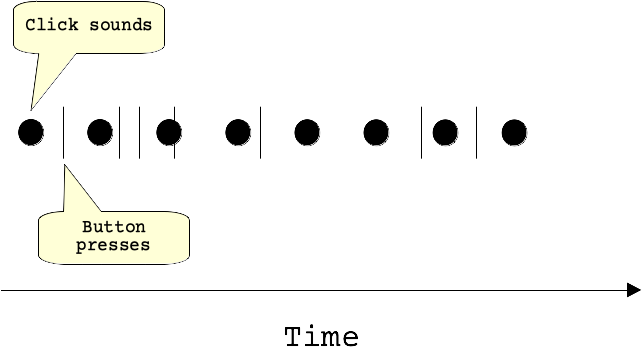
The application knows when the click sound was played and it knows when a button was pressed.
Whenever a button is pressed, the application calculates the difference in time between the button press and the last sound playback.
It uses this information to calculate PMTS (Pravlesian Metronome Score):
- If the difference is between 0 and 99 milliseconds, add 10 points.
- If it is between 100 and 199 milliseconds, add 5 points.
- If it is between 200 and 299 milliseconds, add 1 point.
- Sum up the points for all button presses so far.
- Divide the sum by the number of beats in this session (by 60, if the session lasts for one minute, but 120, if it lasts for two minutes).
If you hit the rhythm perfectly, i. e. all your button presses are within 99 milliseconds of the respective click, PMTS metric will be equal to 100 at the end of the session.
During the session the app would produce an output like this:
1) diff (ms): 0, PMTS: 0.00, 0 playback(s), 1 button press(es)
2) diff (ms): 64, PMTS: 0.83
3) diff (ms): 51, PMTS: 1.67
4) diff (ms): 96, PMTS: 2.50
5) diff (ms): 8, PMTS: 3.33
6) diff (ms): 76, PMTS: 4.17
7) diff (ms): 992, PMTS: 4.17, 6 playback(s), 7 button press(es)
8) diff (ms): 11, PMTS: 5.00
9) diff (ms): 9, PMTS: 5.83
When the number of clicks and buttons presses doesn't match, the difference is displayed so I can correct myself.
The question is: Does this piece of software fulfill its function? Does it actually measure my sense of rhythm with a good-enough precision?
I asked the Neurogirl if she was willing to participate in the following experiment:
- She would do three sessions with my software at 60 BPM (beats per minute) and 60 seconds.
- Then, she would do another three sessions with 60 BPM and 120 seconds.
She agreed and today we did this experiment.
Here are the results:
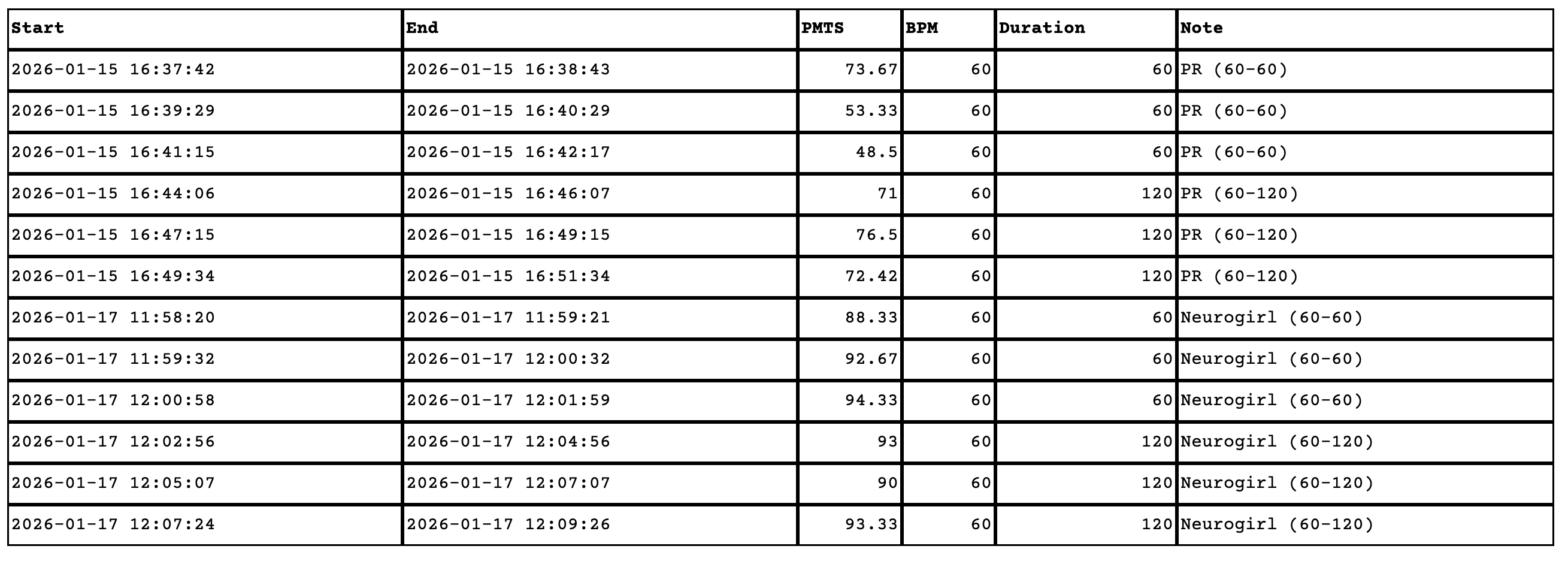
In the Note column, PR means "Pravles Redneckoff."
My top PMTS score in the 60-60 variant is 73.67, whereas Neurogirl's is 94.33. In the 60-120 variant (60 BPM for two minutes) my best time is 76.5 and Neurogirl's – 93.33.
That's a difference of about 20 which means the PMTS metric is good enough.
The tools allows to drill down in the difference of the patterns of my and Neurogirl's tapping. This is what Neurogirl's best 60-120 session looks like:
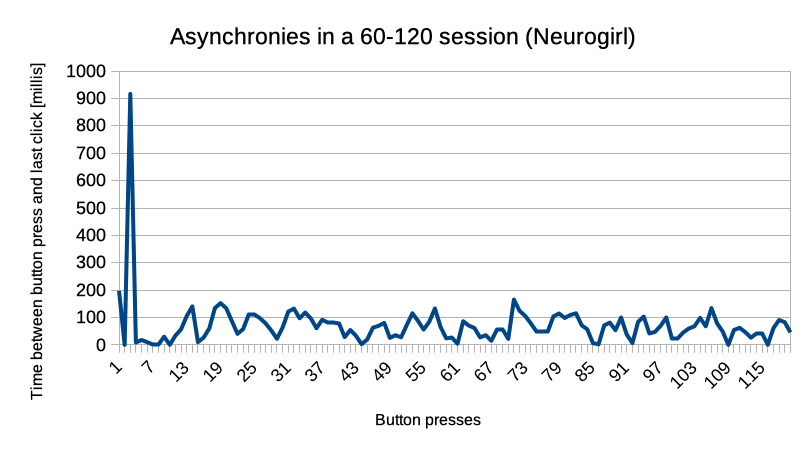
"Asynchrony" is the difference between the time of the button press and the last click.
Here is the same diagram for the same type of session that I did:
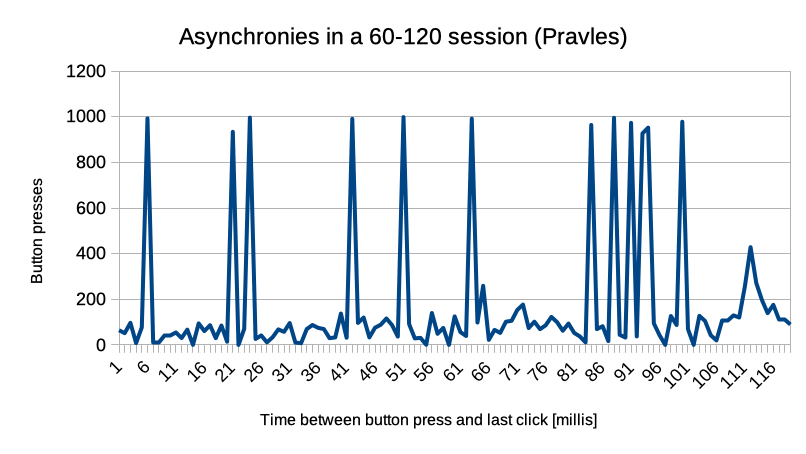
The patterns are visibly different.
Maybe there is something wrong with my brain. Maybe not.
But I wouldn't have discovered this area of improvement without trying to write. This is why writing may be one of the greatest tool for detecting and fixing problems in one's psyche.
Read (and write) books.
Pravles Redneckoff