The Possible Causes of Russophobia
Table of Contents
- 1. The Possible Causes of Russophobia
- 1.1. Disclaimer
- 1.2. Russophobia prevents the formation of Russo-Western alliances
- 1.3. Massive Russophilia would be a black Swan
- 1.4. A piece of anecdotal evidence
- 1.5. A Threat to World Dominance
- 1.6. Russophobia as an Antidote to American Civil Wars
- 1.7. Traditions
- 1.8. Most rational reason for Russophobia
1. The Possible Causes of Russophobia
Hi, there!
One other note about Russians. They ARE wonderful people. Only, you have to get inside, know them as individuals or familes is even better to realize this. On the street you’d think it was a nation of unhappy a**holes.
This is probably one of the biggest reasons there's so much Russophobia in the Western press. Because when western reporters go over there, and they have no base knowledge of the culture, they've got to think, "God these people are a bunch of fucking assholes.”
I'm absolutely certain that this quirk of the Russian people is largely responsible for a great deal of Russophobia.
I think Russophobia has many causes. In this article, I explain some of them.
1.1. Disclaimer
All causes of Russophobia can be divided into two groups:
- Known
- Unknown
I can only write about the known ones. This doesn't mean the unknown causes don't exist.
If a real scientist discovers a new piece of evidence that contradicts the beliefs of mainstream science, then science changes the beliefs to fit the evidence. This doesn't work in history. It's called revisionism and is considered a bad thing.
Since history violates a basic scientific principle, we cannot be sure that the past was as the historians claim it was. There may have been conflicts in the past between the Russians and the West we don't know about.
1.2. Russophobia prevents the formation of Russo-Western alliances
In WWII, before the Germans attacked the Soviet Union in 1941, things were working pretty well for them. After WWII, the Soviet Union and Russia sold cheap energy to Germany, which may have greatly contributed to its prosperity. The Germans were building machines and cars with cheap Russian gas, then selling the products on the Chinese market. Since Germany experienced an economic contraction in the two years following the official end of Russian energy purchases (2023 and 2024), this theory may be correct.
Russians and Germans getting chummy would be a threat to the UK, US, and possibly other powers.
Now imagine a situation when Russia cooperates with the US on a large scale (like they did in WWII or in space). Such an alliance would be an even greater threat to the UK.
Russophobia makes such cooperation impossible. The Germans may find Russophobia useful so that the Russians don't ally with the Americans against the Germans. The British may find Russophobia useful to prevent the Germans and Russians from taking over Europe.
1.3. Massive Russophilia would be a black Swan
I think we've lived through the last couple of centuries in a mode when
- the West criticized Russia whenever it was doing something right (e.g. under Stalin, Putin) and
- praised it when it was destroying itself (e.g. Gorbachev and Yeltsin) or
- when the West was using Russia (e.g. in WWII).
Since any social group wants to survive, the periods when the West criticized Russia are far longer than when it pretended to praise it. We spent most of the time in a Russophobe world. This has been a constant during the last centuries.
Now imagine suddenly lots of Westerners discover Russians are humans like them.
This can lead to all sorts of unpredictable consequences. You replace a constant with a random variable.
Now imagine a deep statesman could turn Russophobia on or off.
(I think this is a realistic thought experiment because most Western media follow a particular line on what one can and cannot say about Russia.)
He would ask himself: We've lived so well for so long with this Russophobia thing going, why would we want to turn it off? Nobody who counts (Westerners) is getting hurt by Russophobia. There is no downside.
What's the upside?
We don't know. But we know that if we stop hating Russians in public, the consequences can be huge and unpredictable.
1.4. A piece of anecdotal evidence
I always believed that the social environment forms the individual. Put a baby into a Russophobe environment and he or she will grow up a Russophobe.
Not any more.
I know two young people. Both of them were born in the West. Both of them had one Russian parent. Both were embedded in Western societies. They watch predominantly Western movies, read predominantly Western books, and talk mostly with Westerners on the street.
Their Russian parents weren't Russophobes, but also didn't impose Russianness on them.
Then, out of the blue, one of those kids hung a Russian flag in their apartment in Amsterdam. Her parents were afraid the neighbors would see it. A few years later she emigrated from Amsterdam to Moscow. She told me she gets way less depressed in Moscow than in Amsterdam.
The other kid declared he felt himself a Russian (despite having spent all his life in Germany). This was after years of anti-Russian propaganda following the escalation of the war in Ukraine in 2022.
None of these people were treated poorly in the West. From what I know, both of them had pretty normal childhoods.
How in the world did two perfectly healthy, well-integrated Western kids turn into Russians? What kind of reward do they expect by voluntarily claiming they are part of an almost universally hated culture?
(Maybe the Plombir ice-cream turns Western kids into Russians, like the Gay bomb turns frogs gay.)
1.5. A Threat to World Dominance
People who behave like those two kids may live according to Russian values, such as
- radical acceptance,
- rationality, and
- the willingness to oppose the group for its own benefit.
People who live according to these values are a tiny minority in every country (incl. Russia). But the minority is greater, percentage-wise, among Eastern Slavs (Russians, Ukrainians, Belarusians) than in, say, Germany.
Everybody who worked with Eastern Europeans will tell you they are more aggressive than Westerners.
Question: Could it be that Eastern Europeans are more confrontational because they are more likely to fight the inefficiency of midwits for the good of the company? Could it be that what Westerners perceive as belligerence is a manifestation of a fundamentally good value?
In this case, any society needs a certain percentage of people practicing Russian values, or it will become ineffective and inefficient (because the midwits and yes-men will ruin everything with their obedience).
Now imagine some globalists want people to give up their freedoms because someone enslaved someone else hundreds of years ago, or a terrible virus is raging all over the planet, or global warming is going to kill us all in five years.
People who practice Russian values will be an obstacle to such policies.
(Maybe this was the reason the plandemic restrictions were less harsh in Russia than in Germany or Austria.)
The globalists have a rational reason to hate the Russians. But not only in Russia. Those two kids are more likely to resist any unreasonable, oppressive measures than Westerners, regardless of where they live.
Plus: If
- perfectly healthy Western babies of Russian parents can turn into Russians when they grow up and
- you as a deep statesman, want your country to be part of a global empire (or building such an empire yourself),
then it makes sense to physically exterminate people who practice or may practice Russian values.
Maybe the Germans knew something I don't know when they designed the Generalplan Ost in the 1930s and 1940s, or when they ship weapons to Ukraine which won't let Ukraine win, but surely will lead to more deaths on both sides.
1.6. Russophobia as an Antidote to American Civil Wars
The Russian writer Semyon Uralov created another theory on the roots of Russophobia.
Relatively soon after its formation, the US fought a civil war. American elites thought they needed to prevent Americans killing Americans again.
This won't happen if the US fights other nations. This is the reason the US has been at war for most of its history. It's better to fight other people than your own.
If you want to fight the Russians, you need to dehumanize them, and here you have another plausible reason for Russophobia.
(I haven't researched Uralov's idea regarding this, so please verify it yourself.)
1.7. Traditions
Some countries are Russophobic because their populations are Russophobic. The Germans fought the Russians twice in the 20th century and are planning to do it a third time somewhere around 2030.
(Although they would be better off having the Russians as their energy supplier.)
I grew up in Austria and originally wanted to assimilate. I absorbed history and culture like a sponge, and in high school I was the undisputed expert on the German language.
But I couldn't become an Austrian for one reason: To be an Austrian, you need to accept the superiority of the Austrian and the inferiority of every other culture.
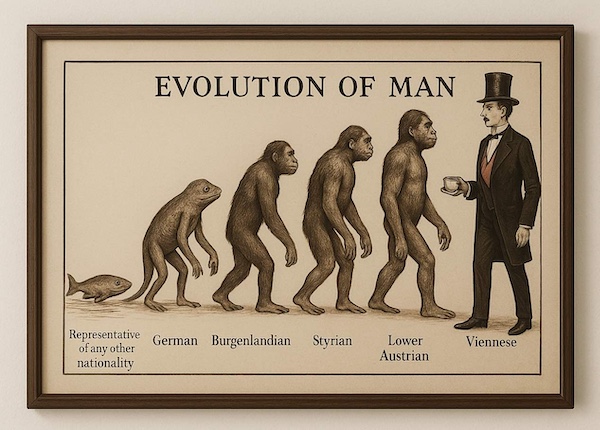
Figure 1: Image from my novel
When it comes to Russians, there are two ways a good Austrian is supposed to talk about them:
- To ridicule them if they are doing something wrong.
- To portray them as evil if they do something right.
Russian achievements in space were ridiculed when something malfunctioned on the Mir station. When it worked as expected, a teacher claimed that the Russians only succeeded in space because they didn't value human life.
When it came to WWII, Austrian teachers portrayed the Russians as invaders and rapists. I don't recall a single instance of an Austrian teacher showing the pupils what their grandfathers did to people in Russia and Ukraine in WWII.
I spent over twenty years in Austria and I can only remember two people who didn't follow those rules. When everybody behaves in a particular way, that behavior creeps into your psyche even if you oppose it.
When I came to Austria, I wanted to become an Austrian and a Christian. After those four years, I hated nothing more than everything Austrian and everything Christian.
This means I've been actively hating the Austrians 14 out of the 20 years I spent there.
Nevertheless, the everyday brainwashing worked on me, and I catch myself thinking Russophobe thoughts even now, after over 4 years that I've been out of Europe.
Here is a little example. Look at the picture below.

Figure 2: Source
It shows a boat on the Moskva River.
When I look at this picture and pay attention to my thoughts and feelings, a part of me experiences cognitive dissonance.
Do you know why?
The Austrian experience makes a part of my psyche expect the boat to be obsolete, or fake, or ridiculous, or evil.
The boat looks modern and, contrary to the expectations of my brainwashed parts, it is self-propelled, not pulled by tortured Ukrainian POWs like in that famous painting.
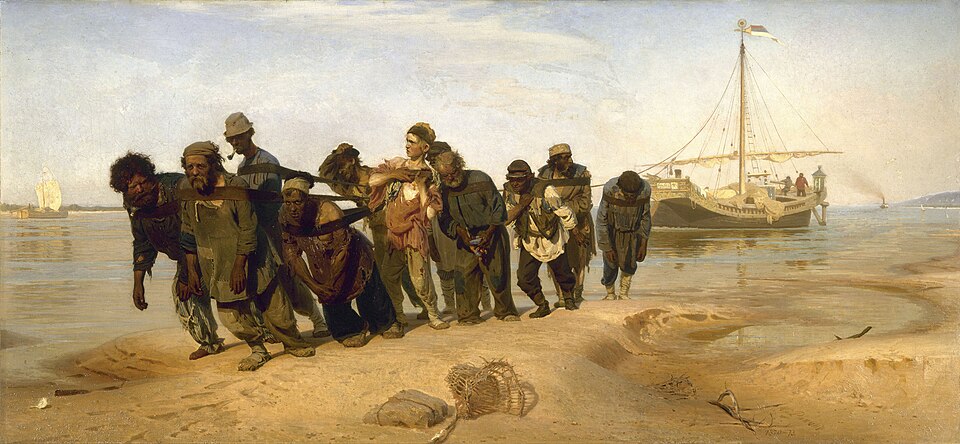
Figure 3: Barge Haulers on the Volga, Ilya Repin. Source
Keep in mind that I'm having these thoughts after traveling between two worlds (Germanophone and Russophone) for a long time, interacting with lots of different people, and broadening my horizons through reading. None of this completely expunged the brainwashing.
Normal people who spend most of their lives in one place will find it even harder to fight their internalized Russophobia (if they even detect it).
1.8. Most rational reason for Russophobia
Finally, there is a very rational reason for Western elites to spread Russophobia.
Russia has a lot of territory with many valuable resources. It's like Africa waiting for its Leopold II of Belgium.
To colonize Russia, you need to conquer it. It's easier to fight people if you don't consider them human.
In a Black Mirror episode, soldiers get implants that make their human enemies look like monsters. This makes them more efficient fighters because it's much easier to kill an animal than a human like yourself.
Dr. Goebbels and his torchbearers in Hollywood have perfected the art of Russophobia to such a degree that most people hate the Russians without any high-tech devices.
Read books.
Pravles Redneckoff