The Reader as a Turing Machine
Table of Contents
- 1. The Reader as a Turing Machine
- 1.1. How not to give advice or feedback to writers
- 1.2. Thesis, Antithesis, Synthesis
- 1.3. Axiom 1
- 1.4. Axiom 1 in business communication
- 1.5. Axiom 2
- 1.6. The Reader as a Turing machine
- 1.7. The typology of atomic reader control actions
- 1.8. Motivation-Reaction Units
- 1.9. Axiom 3
- 1.10. Consequences of axiom 3
- 1.11. Scenes
- 1.12. The Beat Sheet
- 1.13. Limitations of this diagram
- 1.14. Why the diagram is useful despite its limitations
1. The Reader as a Turing Machine
Hi, there!
Someone asked me to provide feedback on their materials on structure of fiction (similar to "Save the Cat", but different). After a few e-mails I got the feeling that it doesn't go well.
1.1. How not to give advice or feedback to writers
My initial assumption was that the process of giving and receiving feedback works like this:
- I look at the materials of the other person.
- I give the other person several suggestions.
- They go through them and decide which suggestions to use and which not.
This approach is wrong. Every human writes differently. By "write" I mean not only typing letters on a page, but the entirety of processes that run in their psyche before, during, and after the actual writing.
The above approach would work in simpler (technical) systems. Max looks how Moritz hits the nail with a hammer. He sees that Moritz holds the hammer wrong. Max shows how to do it right, Moritz repeats it, and puts nails into wood better now.
This approach fails if we deal with a unique being writing a unique piece of fiction given their unique circumstances. We need a better method.
1.2. Thesis, Antithesis, Synthesis
There is a popular concept for designing stories:
- The first act shows the thesis, the usual world.
- The second act shows the antithesis, the upside-down world.
- The third act shows the synthesis, the situation where the hero adapts his usual world view (thesis) under the influence of experiences he had in the upside-down world of the antithesis.
Here is an example:
- Thesis "People are, in general, rational". The hero believes in the rationality of relevant people in his life and has experience to prove it.
- Antithesis "People are beasts who only understand violence". One day the hero gets into a situation where the bad guys want to burn him and his girlfriend alive. The bad guys and the hero don't know each other, so their hatred is irrational. The hero can't negotiate his way out of the situation, and has to apply violence to rescue himself and his girlfriend.
- Synthesis "You must live in a place where the required level of violence matches the one you are willing to apply". The hero and his girlfriend leave the region where your only choice is to be a criminal or the victim.
If we tried to turn the above into a novella or a movie script, the transition from the thesis to antithesis to synthesis would be much more complex than asking yourself "Do I want to use suggestion X from Pravles or not?" Behind each of those three items would stand strong emotions and a lot of thinking.
I think we can use this pattern for sharing ideas on the craft of writing.
- Thesis: The right way to write (yours).
- Antithesis: The wrong way to write (someone else's, e. g. mine).
- Synthesis: The adapted right way (yours).
You know how you do your writing. Then you look how someone else does it, presumably wrong (not suitable for you).
Despite the other person's processes being wrong for you, there may be a thing or two you can borrow from them. You can run experiments and try out their techniques in your work. Those experiments will modify the way you look at the craft of writing. This will be the synthesis: Your own way of writing, augmented by lessons learned from others.
You have your own theory of how fiction works (thesis). Below you find mine (antithesis). Maybe the synthesis of them will be useful to you. In that case, I'd appreciate comment.
1.3. Axiom 1
Often, the better you know the underlying structure of a text, the faster you can write the text.
1.4. Axiom 1 in business communication
Let's look how the axiom 1 applies to communication in a distributed team. Think people in a big, boring bank who work together to make sure that bank's software doesn't fail too often.
Since we don't see most of the team members' faces, we can't find out what they feel. Hence one of the rules is: Whatever we write them must be devoid of emotions. This means, among others, no humor.
If you look at messages people in this setting exchange, you will see that the majority of them is a combination of the following building blocks:
- Question: "Susie, can I deploy application X to server Y?"
- Request: "Susie, please deploy application X to server Y"
- Verdict: "Susie, I've deployed application X to server Y. Let me know if something breaks down." (or "I hereby confirm the appointment in Zoom, on such and such date, at such and such time in such and such time zone.")
This is extremely useful. Whenever I open Outlook or a messenger, I only have four choices:
- I can ask the other party to give me information (question).
- I can ask the other party to do something (request).
- I can notify the other party of something and I don't expect them to answer (verdict).
- If I can't decide which of the three things to write, it means I don't know what I want from the other party. In this case, I need to close Outlook (or the messenger) and think what it is that I want to achieve.
You may say: But Pravles, this is trivial! It's so easy, why do you need this additional layer of abstraction?!
If you say this, your mind is probably in a good shape. You probably had enough sleep, little or no stress, and right now is the time of day where your mind works the best. In this case you don't need structure.
However, if you need to do something at a time when your brain is exhausted (or under stress, or you are sick, or bored to death etc.) the knowledge of that structure helps. Without that structure you have an infinite number of things you can send to your colleagues. With that structure you have to choose one of three options.
This raises the question: If there is structure in the simplest communication, can there be structure in fiction, one which can help write?
1.5. Axiom 2
The only way to write fiction is realist one, i. e. such that the reader can build realistic images of whatever is on the page in their minds.
1.6. The Reader as a Turing machine
A Turing machine is an imaginary computer which reads data from an infinite tape and does calculations based on such instructions. It's highly useful because it abstracts away unnecessary details. For example, in this model, it doesn't matter whether the instructions are read from a disk drive or received via network.
Can we imagine a reader of fiction as a Turing machine?
According to axiom 2, the goal of the writer is to make a movie run in the reader's head. Then we can think of the text on the page as instructions to the reader's psyche. Since those instructions control the reader, we can call them control actions. Those control actions which are supposed to evoke one particular image or idea in the mind of the reader will be called atomic reader control actions (ARCAs).
We can imagine the novel printed on a tape and the reader looking at the tape. If the writer did his or her job well enough, the text on the page will make the psyche of the reader generate moving pictures in their mind, like a movie, but better because those pictures will be personalized and include smells.

1.7. The typology of atomic reader control actions
The number of control actions is limited by axiom 2 and laws of nature. We can only put on the page what exists in the real world.
These are all possible reader control actions I'm aware of:
ARCA.VAKOG: Character perceives something using the five senses (visual, auditory etc.)ARCA.THINK: Character thinks or remembers something.ARCA.FEEL: Character feels something.ARCA.MOVE: Character moves.ARCA.SAY: Character says something.ARCA.MIME: Character mimes something.ARCA.PHYSICAL: Character interacts physically with an object or a person.
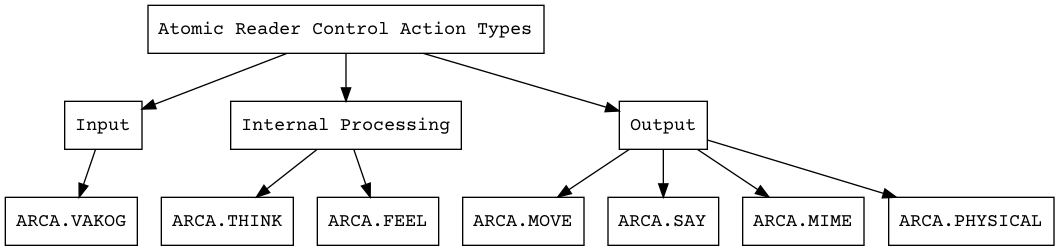
If you look carefully you may notice a pattern:
- Some control actions make a character receive information (
ARCA.VAKOG). - Others make him or her process information internally (
ARCA.THINK,ARCA.FEEL). - The rest is about the character emitting words or actions (
ARCA.MOVE,ARCA.SAY,ARCA.PHYSICAL,ARCA.MIME).
1.8. Motivation-Reaction Units
In his book "Techniques of the Selling Writer" Dwight D. Swain writes about a so-called motivation-reaction unit as a basic building block of fiction. Such a unit consists of
- a motivating stimulus and
- a response.
A motivating stimulus is anything outside of the point-of-view character to which he or she reacts. We can marry Dwight D. Swain's idea with our ARCAs and represent it as follows.

The motivating stimulus can only contain things the character can see, hear, smell or perceive via other senses.
In the response part of the MR unit, the character can think and emote (internal responses) and output the results of that thinking and feeling.
1.9. Axiom 3
The more freedom a writer has, the harder it is to write.
Conversely, the more constraints there are, the easier it is to write.
1.10. Consequences of axiom 3
People who are wrong on the internets sometimes say you should write from the heart, in the way you like it. This is terrible advice if you want to write
- a lot and
- in a suboptimal state (when you are tired, stressed, hadn't slept enough or well enough etc.).
If you can write whatever you want, and your mind is tired, it is likely to write nothing.
The structure above reduces your choices similar to that of the business communication.
There are some rules for writing the motivation-response units. They limit what you can do and where.
For example, the only thing that can happen in the motivating stimulus is the character perceiving something.
What can he or she perceive?
It depends on the location and the part of the story where that scene happens. Assuming that these two things are fixed before writing, it becomes easier to determine what a character can see, hear, or smell at that place and that time. Then you choose the perception which you can use to make the point you want to make.
1.11. Scenes
One level above the motivation-reaction unit is the scene. According to Story Grid, a scene has the following elements:
- Inciting Incident
- Progressive Complications
- Crisis
- Climax
- Resolution

We could say that sometimes those elements can be thought of as complex reader control actions (those which consist of one or more atomic ones).
1.12. The Beat Sheet
Then we have the usual three-act structure. We can say that often, each of its beats is a collection of scenes.
We could create the following model of the structure of a novel.
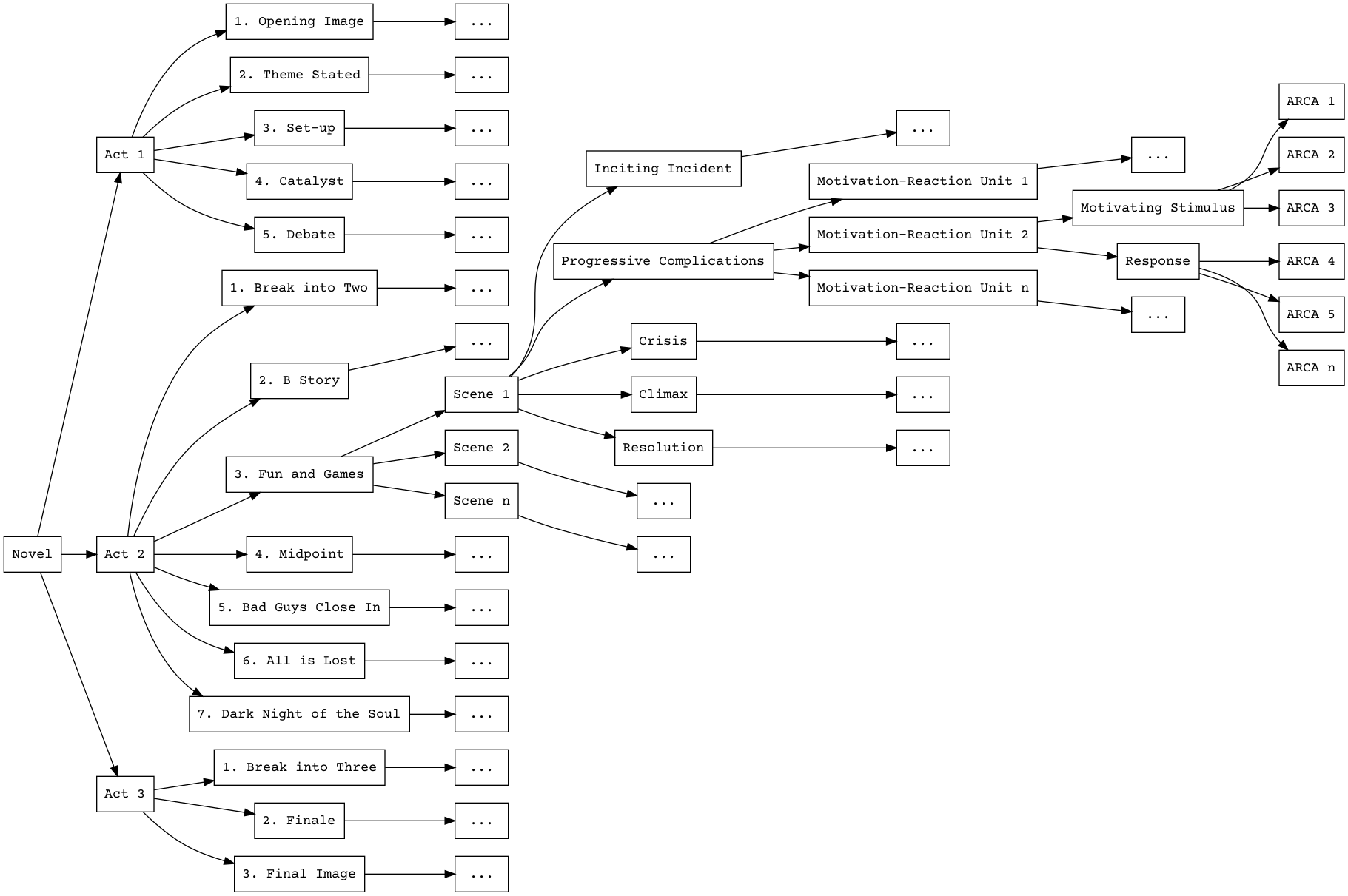
A novel consists of three acts. Every act consists of multiple beats ("Opening Image", "Theme Stated" etc.). Every beat consists of one or more scenes. Each scene has five elements mentioned above (inciting incident, progressive complications etc.). Each of those elements consists of one or more motivation-reaction units which, in turn, consist of a motivating stimulus and a response. Finally, the stimuli and responses consist of one or more ARCAs.
1.13. Limitations of this diagram
The above diagram is a model and (like any model) is not a perfect representation of reality.
- Subplots are not included.
- Sometimes a beat can be an ARCA, e. g. "Theme Stated" could be a piece of dialogue between the protagonist and another character in which the latter states the theme.
- Sometimes, the resolution is not a separate ARCA, but some cool sentence you add at the end of the chapter.
- Most of the elements in this diagram don't have rigorous definitions rooted in logic and laws of nature.
1.14. Why the diagram is useful despite its limitations
First, viewing a novel in this way is much better than as a collection of chapters, paragraphs, and sentences. Diagram presented above is intended for writing fiction, the chapter-centric model is useful for tracking progress while reading it.
This diagram suggests that a novel is designed from left to right. On the left, you express the theme of your novel in the language of events. On the right, you convert those events to instructions for the reader's psyche. These are different types of activities, the former being harder than the latter.
Second, a diagram like this can increase the processing speed of your brain. There is a reason the structure of an airplane is represented using visual means. If writing a novel is as hard for you as it is for me, it makes sense to use any opportunity to improve your mind's efficiency.
Third, thinking about the novel in this or similar ways can help you design your own language of structure. By "language" I mean any means to represent something in writing or in your mind.
Consider the Roman number system. In that system the statement "10 times 10 equals 100" would look like this:
X x X = C
The Arabic system is much more intuitive – you just add a 0 at the end. The more complex the math you do, the greater the benefits of the right language will be.
(Has anybody done calculus with the Roman system?)
When you design, write, and edit a novel you wield structural information in your mind. The better the language in which that structure is represented, the easier it will be and the faster the novel will be completed.
Fourth, looking at fiction as discussed here may be a countermeasure against the corruption of minds perpetrated by the education system.
According to Hilary Laine (video, text companion), modern schools teach children to read in the wrong way. Instead of evaluating the text on the page and its meaning, children are encouraged to think what the text makes them feel. When they grow up, they write fiction of poor quality because they don't really know how to read, i. e. how to extract from the written text the meaning that's encoded there, not just your emotions about it.
This diagram makes it clearer that works of fiction are devices engineered to produce a response in the reader.
Read books.
Pravles Redneckoff